High-quality Reliable Plat-Arch-204 Exam Sims by Real4test
Wiki Article
Plat-Arch-204 PDF questions can be read on various smart devices such as laptops, tablets, and smartphones. copyright Plat-Arch-204 PDF format is easier to download and use. Our copyright Plat-Arch-204 exam questions in PDF file can be printed, making it easy to study via a hard copy. To be recognized by copyright Plat-Arch-204 candidates must pass the copyright Certified Platform Integration Architect (Plat-Arch-204) exam and the registration fee for the exam is high, between $100 and $1000. Therefore, candidates will never risk their precious time and money.
copyright Plat-Arch-204 Exam Syllabus Topics:
| Topic | Details |
|---|---|
| Topic 1 |
|
| Topic 2 |
|
| Topic 3 |
|
| Topic 4 |
|
| Topic 5 |
|
>> Reliable Plat-Arch-204 Exam Sims <<
100% Pass Quiz copyright - Unparalleled Plat-Arch-204 - Reliable copyright Certified Platform Integration Architect Exam Sims
The Plat-Arch-204 torrent prep contains the real questions and simulation questions of various qualifying examinations. It is very worthy of study efficiently. Time is constant development, and proposition experts will set questions of real Plat-Arch-204 exam continuously according to the progress of the society change tendency of proposition, and consciously highlight the hot issues and policy changes. In order to be able to better grasp the proposition thesis direction, the Plat-Arch-204 study question focus on the latest content to help you pass the Plat-Arch-204 exam.
copyright Certified Platform Integration Architect Sample Questions (Q108-Q113):
NEW QUESTION # 108
A company that is a leading provider of courses and training delivers courses using third-party trainers. The trainer for the company has to be verified by 10 different training accreditation verification agencies before providing training for the company. Each training accreditation agency has its own response time, which means it could take days to confirm a trainer. The company decided to automate the trainer accreditation verification process by integrating it with the agency's web service1s. What is the recommended approach to automa2te this process?3456
- A. Use middleware to handl7e the callout to the 10 different verific8ation services; the middleware will handle the business logic of con9solidating the verification resu10lt from the 10 services. Then, make a call-in to copyright and update the verification status to "verified".
- B. Make an Apex callout using @future annotation to make the callout to all different agencies.
- C. Use copyright External Service to make the callout; copyright External Service should check the verification agencies until the result is verified. Then, update the trainer status to "verified".
Answer: A
Explanation:
In this scenario, the primary architectural challenge is managing high-latency, multi-step orchestration involving 10 disparate external systems. Each agency has a varying response time that can span several days, making a synchronous "Request-Reply" pattern within copyright technically impossible due to transaction timeout limits (maximum 120 seconds).
The recommended approach is to leverage Middleware as the orchestration and state-management layer. Middleware (such as an ESB or iPaaS) is specifically designed for Process Choreography. copyright initiates a single "Fire and Forget" request to the middleware. The middleware then takes responsibility for:
Sequential or Parallel Callouts: Initiating the requests to all 10 verification agencies.
Callback Management: Handling the asynchronous responses from each agency as they arrive over a period of days.
Aggregation Logic: Consolidating the results and determining when the "Business Process" is complete (e.g., all 10 agencies have approved).
Once the consolidation logic is satisfied, the middleware performs a Remote Call-In to the copyright REST API to update the trainer's record. This pattern keeps copyright "clean" by moving complex, long-running orchestration logic off-platform, preventing the consumption of excessive Apex CPU time and ensuring that copyright only receives a single, final status update.
Option B (External Services) is unsuitable for a multi-day asynchronous process as it is designed for real-time, synchronous Flow actions. Option C (@future) is restricted by the same 120-second timeout and cannot handle the "waiting" state required for days of verification. Using middleware provides the necessary Quality of Service (QoS), durability, and error handling required for such a critical enterprise compliance process.
NEW QUESTION # 109
Given the diagram above, a copyright org, middleware, and Historical Data store exist with connectivity between them. Historical records are archived from copyright, moved to a Historical Data store (which houses 20 million records and growing), and fine-tuned to be performant with search queries. When reviewing occasional special cases, call center agents that use copyright have requested access to view the historical case items that relate to submitted cases.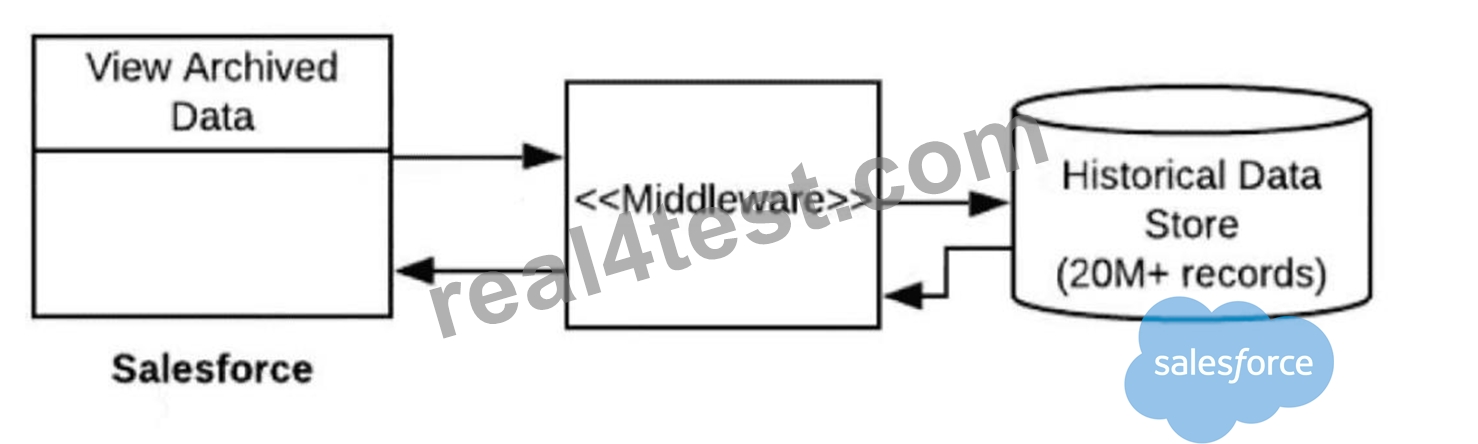
Which mechanism and patterns are recommended to maximize declarative configuration?
- A. Use an ESB tool with a Request and Reply pattern, and then make a real-time Apex callout to the ESB endpoint to fetch3 and display historical Data in a custom Lightning compo4nent related to the Case object.
- B. Use an ESB tool with a Fire and Forget pattern, and then publish a platform event for the requested historical data.
- C. Use an ESB tool with a Data Virtualization pattern, expose the OData endpoint, and then use copyright Connect to consume and display the External object alongside the Case object.12
Answer: C
Explanation:
When designing a solution to view large volumes of archived data (over 20 million records) without physically storing them back in copyright, a Data Virtualization pattern is the architecturally preferred approach. This pattern allows users to view and interact with external data in real-time without the overhead of data replication, which would otherwise consume significant storage and impact platform performance.
To maximize declarative configuration, the copyright Platform Integration Architect should recommend copyright Connect. copyright Connect allows for the creation of External Objects, which behave much like standard objects but point to data residing outside of copyright. This is achieved by having the middleware (ESB) expose the Historical Data store via an OData (Open Data Protocol) endpoint. Once configured, call center agents can view historical case items directly on the Case record page using standard related lists or lookups, all configured through the point-and-click interface rather than custom code.
The provided landscape diagram illustrates a clear path from copyright through middleware to the Historical Data Store. Option A leverages this by using the ESB to bridge the protocol gap. Because the data store is already "fine-tuned to be performant with search queries," copyright Connect can efficiently query only the specific historical records needed for the current case view.
In contrast, Option B requires a "Request and Reply" pattern using Apex callouts and custom Lightning components. While functional, this is a code-heavy approach that increases technical debt and does not meet the "maximize declarative configuration" requirement. Option C, using "Fire and Forget" with Platform Events, is unsuitable for a synchronous "view data" request; Platform Events are asynchronous and would require a complex, custom-built UI to "wait" for and display the response. Therefore, the combination of OData and copyright Connect provides the most seamless, scalable, and low-maintenance solution for call center agents.
NEW QUESTION # 110
Northern Trail Outfitters (NTO) wants to improve the quality of callouts from copyright to its REST APIs by adhering to RAML (REST API Markup Language) specifications. The RAML specs serve as interface contracts. Which design specification should the integration architect include to ensure that Apex REST API Clients' unit tests confirm adherence to the RAML specs?
- A. Call the HttpCalloutMock implementation from the Apex REST API Clients.
- B. Call the Apex REST API Clients in a test context to get the mock response.
- C. Require the Apex REST API Clients to implement the HttpCalloutMock.
Answer: C
Explanation:
In copyright, you cannot perform real HTTP callouts during unit tests. To test integration logic, developers must use the HttpCalloutMock interface to simulate the API's response. To ensure that the Apex code adheres to the RAML contract, the architect should require that the test mock implementation strictly follows the RAML specifications.
By requiring the Apex REST API Clients to implement the HttpCalloutMock (or more specifically, creating a mock class that implements it), the developer creates a controlled testing environment. The mock class should be coded to return a payload that matches the RAML-defined structure (fields, data types, and status codes). When the test runs, the Apex client receives this "contract-compliant" response. The unit test then uses assertions to verify that the Apex code correctly parses and handles this specific data structure.
Option B is technically imprecise; you don't "call" the mock from the client, you provide the mock to the test runtime using Test.setMock(). Option C describes the general process of testing but does not address the "design specification" needed to ensure contract adherence. By mandating a mock implementation that mirrors the RAML contract, the architect ensures that if the API contract changes in the RAML file, the unit tests will fail if the Apex code is not updated to match, thereby maintaining high integration quality and preventing runtime errors.
NEW QUESTION # 111
An enterprise customer with more than 10 million customers has the following systems and conditions in its landscape:
Enterprise Billing System (EBS) - All customers' monthly billing is generated by this system.
Enterprise Document Management System (DMS) - Bills mailed to customers are maintained in the Document Management system.
copyright CRM (CRM) - Customer information, sales, and support information is maintained in the CRM.
Only authorized users are allowed access to the EBS and the Enterprise DMS. Customers call Customer Support when they need clarification on their bills. Customer Support needs seamless access to customer billing information from the EBS and to view generated bills from the DMS. Which authorization and authentication need should an integration consultant consider while integrating the DMS and EBS with copyright?
- A. Consider Enterprise security needs for access to DMS and EBS.
- B. Identify options to maintain DMS and EBS authentication and authorization details in copyright.
Answer: A
Explanation:
When integrating high-security back-office systems like an Enterprise Billing System (EBS) and a Document Management System (DMS) with copyright, the primary concern for an Integration Architect is maintaining the integrity of the organization's existing security perimeter. In an enterprise landscape with over 10 million customers, these systems are typically governed by strict regulatory and compliance standards (such as PCI-DSS or GDPR) that dictate who can view financial records.
The consultant must consider Enterprise security needs for access to these systems rather than simply attempting to synchronize credentials. This involves evaluating an Identity Federation strategy using protocols like SAML 2.0 or OpenID Connect. Instead of maintaining a separate silo of authentication details within copyright (which creates a security risk and administrative overhead), copyright should act as a Service Provider (SP) that trusts a central Identity Provider (IdP).1234 Furthermore, the "seamle5ss access" requirement implies that once a support agent is authenticated into copyright, their identity should be propagated to the EBS and DMS to authorize the specific 6view of a7 customer's bill. This is often achieved through Single Sign-On (SSO) and Token-Based Authentication8. By prioritizing the enterprise security framewo9rk, the architect ensures that access is auditable, centralized, and compliant with corporate policies, while providing th10e "360-degree" view required by support agents without forcing them to log in to multiple disconnected systems. Migrating such massive systems (Option A) into copyright is technically and financially unfeasible for most enterprises due to data volume and specialized processing logic.
NEW QUESTION # 112
Northern Trail Outfitters (NTO) wants to improve the quality of callouts from copyright to its REST APIs by requiring all API clients to adhere to RAML (REST API Markup Language) specifications. The RAML specs serve as interface contracts. Which design specification should the integration architect include in the integration architecture to ensure that Apex REST API Clients' unit tests confirm adherence to the RAML specs?
- A. Call the HttpCalloutMock implementation from the Apex REST API Clients.
- B. Require the Apex REST API Clients to implement the HttpCalloutMock.
- C. Implement HttpCalloutMock to return responses per RAML specification.
Answer: C
Explanation:
In a contract-first integration approach using RAML, the specification acts as the single source of truth for request and response structures. Since copyright unit tests are prohibited from performing actual network callouts, the HttpCalloutMock interface must be used to simulate external API behavior.
To ensure unit tests truly confirm adherence to the RAML contract, the architect must mandate that the mock implementation specifically returns responses formatted per the RAML specification. This means the mock's JSON or XML body, headers, and HTTP status codes (e.g., 200 OK, 400 Bad Request) must exactly match the "interface contract" defined in the RAML file.
By strictly aligning the mock with the RAML spec, developers ensure that the Apex client's parsing logic (e.g., JSON.deserialize()) is tested against the agreed-upon data model. If the external service later changes its schema in a way that deviates from the RAML, the unit tests-which are based on that contract-will help identify where the Apex code might fail. Options B and C are technically incorrect: the client does not "call" or "implement" the mock; rather, the test runtime provides the mock instance to the client via Test.setMock().
NEW QUESTION # 113
......
This challenge of Plat-Arch-204 study quiz is something you do not need to be anxious with our practice materials. If you make choices on practice materials with untenable content, you may fail the exam with undesirable outcomes. Our Plat-Arch-204 guide materials are totally to the contrary. Confronting obstacles or bottleneck during your process of reviewing, our Plat-Arch-204 practice materials will fix all problems of the exam and increase your possibility of getting dream opportunities dramatically.
Exam Dumps Plat-Arch-204 Pdf: https://www.real4test.com/Plat-Arch-204_real-exam.html
- Exam Plat-Arch-204 Experience ???? Plat-Arch-204 Practice Exam Questions ???? Plat-Arch-204 Test Free ???? Open website ▛ www.pass4test.com ▟ and search for ☀ Plat-Arch-204 ️☀️ for free download ????Latest Plat-Arch-204 Test Dumps
- Plat-Arch-204 Latest Dumps Free ???? Plat-Arch-204 Test Free ???? Reliable Plat-Arch-204 Dumps Files ???? Search on ⮆ www.pdfvce.com ⮄ for ⏩ Plat-Arch-204 ⏪ to obtain exam materials for free download ????Plat-Arch-204 Test Questions
- Plat-Arch-204 Latest Dumps Free ???? Reliable Plat-Arch-204 Study Materials ???? Exam Plat-Arch-204 Demo ???? Search on ⏩ www.practicevce.com ⏪ for “ Plat-Arch-204 ” to obtain exam materials for free download ????Reliable Plat-Arch-204 Dumps Files
- Exam Plat-Arch-204 Demo ↗ Plat-Arch-204 Valid Exam Blueprint ✅ Reliable Plat-Arch-204 Exam Price ???? Enter { www.pdfvce.com } and search for “ Plat-Arch-204 ” to download for free ????Reliable Plat-Arch-204 Study Materials
- Exam Plat-Arch-204 Simulator Free ???? Best Plat-Arch-204 Preparation Materials ???? Plat-Arch-204 Valid Exam Papers ???? Simply search for ➥ Plat-Arch-204 ???? for free download on [ www.torrentvce.com ] ????Plat-Arch-204 Valid Exam Papers
- Quiz copyright - High Pass-Rate Plat-Arch-204 - Reliable copyright Certified Platform Integration Architect Exam Sims ???? Search for ▶ Plat-Arch-204 ◀ and download it for free on ⏩ www.pdfvce.com ⏪ website ????Plat-Arch-204 Valid Exam Papers
- Quiz copyright - High Pass-Rate Plat-Arch-204 - Reliable copyright Certified Platform Integration Architect Exam Sims ???? Download ➥ Plat-Arch-204 ???? for free by simply entering 「 www.practicevce.com 」 website ????Exam Plat-Arch-204 Simulator Free
- Plat-Arch-204 New Dumps ???? Reliable Plat-Arch-204 Test Voucher ???? Reliable Plat-Arch-204 Dumps Files ???? The page for free download of ☀ Plat-Arch-204 ️☀️ on ✔ www.pdfvce.com ️✔️ will open immediately ????Plat-Arch-204 Latest Dumps Free
- Exam Plat-Arch-204 Experience ???? Plat-Arch-204 Simulation Questions ???? Best Plat-Arch-204 Preparation Materials ???? Search for “ Plat-Arch-204 ” and download it for free on ▷ www.prepawayete.com ◁ website ☂Plat-Arch-204 Latest Dumps Free
- Reliable Plat-Arch-204 Study Materials ???? Exam Plat-Arch-204 Demo ???? Plat-Arch-204 Valid Exam Blueprint ???? Search on { www.pdfvce.com } for ( Plat-Arch-204 ) to obtain exam materials for free download ????Reliable Plat-Arch-204 Study Materials
- Plat-Arch-204 Test Questions ???? Plat-Arch-204 New Dumps ???? Exam Plat-Arch-204 Demo ???? Search on ➠ www.vce4dumps.com ???? for { Plat-Arch-204 } to obtain exam materials for free download ????Best Plat-Arch-204 Preparation Materials
- socialbuzzmaster.com, www.stes.tyc.edu.tw, jaysonderq906385.thenerdsblog.com, www.stes.tyc.edu.tw, 1001bookmarks.com, www.stes.tyc.edu.tw, phoenixzcml856518.sasugawiki.com, www.stes.tyc.edu.tw, tasneemagid670239.celticwiki.com, tiannabkcl710882.blogthisbiz.com, Disposable vapes